

Quick answer: YouTube works for B2B lead generation because buyer-intent searches (“how to fix X problem”) are just as common in B2B as consumer markets — the businesses that struggle are posting awareness content instead of answering searched questions. The fix is targeting buyer-intent topics, qualifying viewers inside the video, and placing a spoken call-to-action right after naming their problem. This guide walks through the full views-to-booked-calls funnel.
YouTube lead generation for B2B works. Most founders just never build the part of the system that turns a view into a booked call, so they conclude YouTube “doesn’t work for B2B” when really they never gave it a job to do beyond getting watched.
I’ve used this exact approach — attract the right viewer, qualify them fast, convert them to a lead — as part of a playbook that’s driven 10M+ views and 67K+ subscribers across the channels I work on. None of that came from posting and hoping. It came from treating every video as a step in a funnel, not a standalone piece of content.
If you’re a consultant, agency owner, or B2B founder wondering whether YouTube can actually fill your calendar with sales calls — not just views — this is the exact mechanism, start to finish.
Why YouTube Beats Most B2B Channels for Lead Generation#
Here’s the contrast that matters: a LinkedIn post has a shelf life of about 24 to 48 hours before the feed buries it. A YouTube video keeps showing up in search and suggested results for a year or more after you publish it. One is a campaign. The other is an asset.
That difference compounds. A channel publishing one buyer-intent video a week for six months has 26 videos still working for it in month seven, each one still capable of showing up when the right person searches the right question. LinkedIn gives you almost none of that residual value — you’re re-fighting for attention with every single post.
None of this means drop LinkedIn. It means understand that YouTube is doing a different job: it’s building a compounding asset, not a daily impression.
How a YouTube View Actually Becomes a Booked Call#
Think of this as a funnel with four real steps, not a straight line from “watched” to “bought.”
Someone searches a buyer-intent question and finds your video. This only works if the topic was a real search in the first place — a video answering “how to reduce client churn” pulls in buyers; a video titled “My Thoughts on the Industry” pulls in nobody with money to spend.
They watch enough to trust that you understand the problem. This is where naming the specific pain point, using their language instead of your internal jargon, does the qualifying work. If they don’t recognize themselves in the first sixty seconds, they’re gone.
They take one small, specific action. A calculator, a checklist, a template, a short assessment — something that extends the exact video they just watched instead of dumping them on a generic homepage. This is the single biggest lever in the entire funnel, and it’s the step most B2B channels skip entirely.
They book a call because the offer that follows fits the problem they just self-identified. By the time someone reaches this step, most of your sales conversation has already happened inside the video. The call isn’t a cold pitch anymore — it’s a scheduled continuation of a conversation the viewer started with themselves.
Where Should Your Call-to-Action Actually Go?#
Placement matters more than most creators assume, and it’s not the description link doing the heavy lifting. Said out loud, mid-video, a specific and well-timed CTA consistently outperforms every other placement — pinned comments, end screens, and description links included.
That doesn’t mean skip the description. It means don’t rely on it alone. Say the CTA once, clearly, at the moment in the video where the viewer’s problem has just been named in full — right after you’ve described their pain in a way that makes them think “that’s exactly my situation.” Then reinforce it in the description’s first two lines, since that’s the only part most viewers see before “show more” collapses the rest.
Which YouTube Topics Actually Generate B2B Leads?#
Buyer-intent topics beat awareness-stage topics every time for lead generation specifically. “How to reduce onboarding time for new hires” is a buyer-intent search from someone actively dealing with the problem right now. “The Future of HR Tech” is a spectator topic — interesting, forgettable, and rarely searched by someone about to buy anything.
A useful filter: would someone type this exact phrase into a search bar while actively trying to solve a problem, or would they only watch this because it happened to appear in their feed? The first kind of topic builds a lead-generation engine. The second kind builds an audience that likes you and never buys anything. (A full framework for finding and validating these topics is coming in a dedicated cluster article — see the pillar guide below.)
How Long Does It Take to See Leads From YouTube?#
Slower to start than a LinkedIn post, faster to compound than almost anything else you’re doing. Channels publishing one buyer-intent video a week typically see their first consistent leads within three to four months — not their first view, their first lead, which takes longer because it depends on search visibility building up, not just publishing.
The upside is durability: a video published today can still be generating leads eighteen months from now, long after a LinkedIn post from the same week has been buried under ten thousand others. Judge this channel like you’d judge planting an orchard, not running a sprint — the trade is a slower start for a much longer payoff.
What This Looks Like End to End#
Here’s a small automation example from my own systems, not a B2B lead funnel specifically, but the same principle: when a call gets booked through Cal.com, it should never sit as a name in a calendar app doing nothing. It should land somewhere your team actually works from.
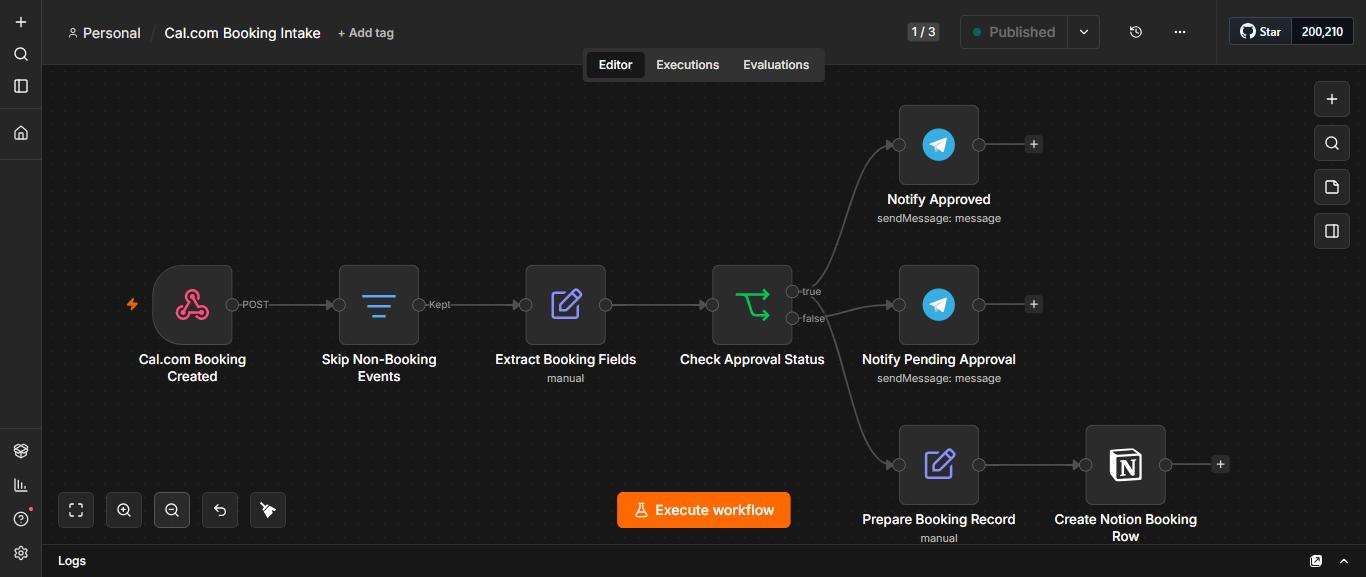
The workflow below routes a booked call straight from Cal.com into a CRM record automatically — no one manually copying details, no lead falling through a crack between “they booked” and “someone follows up.”
Whatever your booking tool is, the same rule applies to your YouTube funnel: the moment someone takes the small action inside your video, that action needs to land somewhere real, immediately, with zero manual steps standing between “they clicked” and “someone follows up.” That’s the difference between a funnel that occasionally produces a customer and one that reliably fills a calendar.
Turning This Into a System, Not a One-Off Campaign#
Everything above works as a single campaign — run it once and you’ll likely get a handful of leads. Running it as a system, where every new video plugs into the same funnel and the CTA gets refined based on what’s actually converting, is what turns occasional leads into a predictable pipeline.
That system-level view — how Attract, Qualify, Convert, and a repeatable Engine fit together across your entire channel, not just one video — is the full arc covered in How to Get Customers From YouTube: The Complete Founder’s Guide. If you found this useful, that’s the piece that ties it into everything else your channel needs to be doing.
For the worksheets that walk you through mapping your own funnel step by step, instead of reverse-engineering it from a blog post, that’s exactly what Built the Product. Now Get Customers. is built to do.
Frequently Asked Questions#
Does YouTube actually work for B2B lead generation?#
Yes. B2B buyers research heavily before ever speaking to a salesperson, and buyer-intent search behavior on YouTube looks very similar to what happens on Google — someone searching “how to fix X problem” is a real, qualifiable lead, not just a viewer. The businesses that struggle with YouTube for B2B are usually the ones posting awareness-stage content instead of answering searched questions.
How do I get leads from YouTube without paid ads?#
Focus on buyer-intent topics your ideal customer is actively searching, qualify them clearly inside the video by naming who it’s for, and give them one specific, low-friction next step tied to that exact video. This system runs entirely on organic search and requires no ad spend, though ads can accelerate it once the funnel is proven.
Where should I put my call-to-action in a YouTube video for B2B leads?#
Say it out loud, mid-video, right after you’ve fully named the viewer’s problem — that placement consistently outperforms pinned comments, end screens, and description-only links. Reinforce it in the first two lines of your description, since that’s the only part most viewers see without clicking “show more.”
How many leads can I expect from a YouTube video?#
It depends heavily on topic selection and how well the video qualifies its viewers, so there’s no universal number — but as a rough shape, expect only a small percentage of viewers to click through to a lead magnet, and a smaller percentage of those to book a call. The lever that moves those numbers most is topic-to-offer relevance, not production quality.
What’s the difference between YouTube leads and LinkedIn leads for B2B?#
YouTube leads take longer to start arriving but keep coming for a year or more after a video is published, since it keeps showing up in search. LinkedIn leads arrive faster but drop off within days as the post gets buried in the feed. The two aren’t competitors — they solve different timing problems, and most founders benefit from running both.